

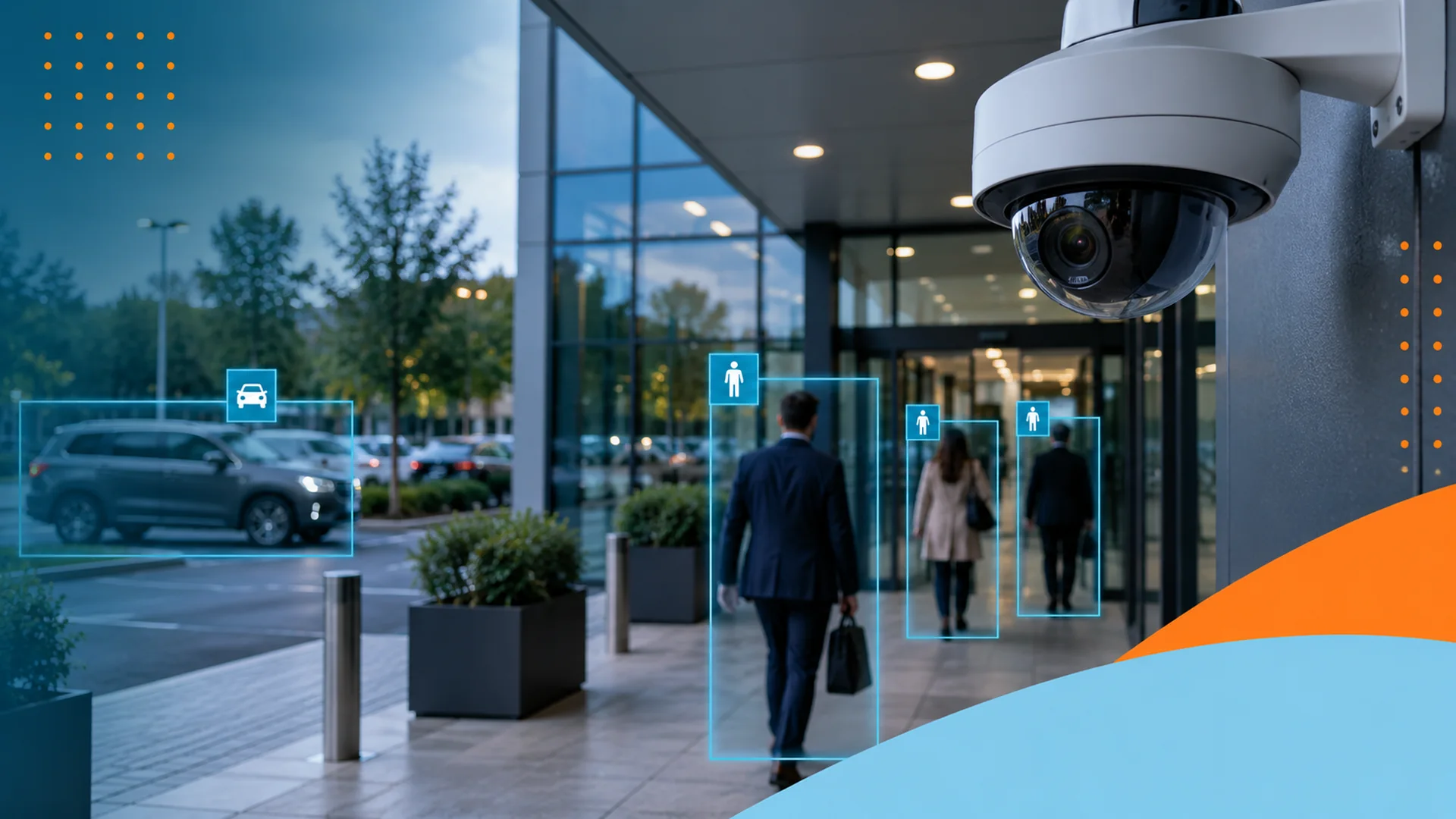
Modern CCTV can identify events, behaviours and potential risks automatically. But not every feature labelled “AI” will deliver meaningful value to your organisation.
CCTV has changed considerably.
For many years, the basic objective was straightforward: install cameras, record footage and review it if something happened.
Modern CCTV systems can do much more.
Analytics can now identify people and vehicles, monitor defined areas, recognise unusual movement, detect someone crossing a virtual boundary and alert security teams when specific events occur.
Increasingly, these capabilities are being marketed as AI-powered CCTV.
Some of it represents a genuine improvement in how organisations protect buildings, people and assets.
Some of it is simply a more impressive label for functions that have existed in various forms for years.
The important question for businesses is not whether a CCTV system includes AI.
It is whether the analytics solve a genuine operational or security problem.
What does AI CCTV actually do?
There is no single feature called AI CCTV.
The term covers a wide range of video analytics that use software to interpret what a camera is seeing rather than simply recording an image.
Depending on the equipment and software being used, this can include:
- distinguishing people from vehicles
- virtual line crossing
- intrusion detection
- loitering alerts
- vehicle detection
- object left or removed alerts
- occupancy monitoring
- people counting
- movement in restricted areas
- unusual activity alerts
- number plate recognition
- searching recorded footage by object or event
This is a significant change from traditional motion detection.
Older systems could generate an alert simply because something moved.
That movement might have been a person, a tree blowing in the wind, heavy rain or an animal passing the camera.
Modern analytics can be considerably more selective.
That potentially means fewer irrelevant alerts and more attention directed towards events that actually matter.
TCNS Cabling designs and installs CCTV systems around the environment being protected rather than simply increasing camera numbers.
Where analytics add real value
The strongest CCTV analytics are often the simplest.
They solve a clearly defined problem.
Perimeter protection
Imagine a commercial site that should be empty overnight.
A conventional CCTV system might record somebody entering the grounds.
An analytics-enabled system can potentially identify that a person has crossed a defined boundary and immediately generate an alert.
The difference is important.
One system provides evidence after an event.
The other can potentially help the organisation respond while the event is happening.
For warehouses, commercial estates, schools and industrial sites, that can be genuinely valuable.
Restricted areas
The same principle can be used inside buildings.
Some areas may only be accessible to authorised staff.
Analytics can help identify movement within areas that should normally remain empty or detect activity outside expected operating hours.
CCTV can also form part of a broader physical security strategy alongside door entry and access control.
The two technologies perform different functions, but when properly designed they can complement each other.
Faster investigations
One of the less dramatic but potentially more useful developments is intelligent video search.
Consider a site with dozens of cameras recording continuously.
If an incident occurs, somebody may otherwise have to review a significant amount of footage manually.
Modern video management platforms can make it easier to search for particular events, people, vehicles or movement within defined areas.
That can significantly reduce the amount of time spent finding relevant footage.
For security teams managing larger estates, this may deliver more day-to-day value than some of the more heavily marketed AI features.
Operational uses beyond security
CCTV analytics are also increasingly used for operational purposes.
A camera does not necessarily need to be looking for crime.
Video analytics can potentially help organisations understand how buildings and sites are being used.
Examples might include:
- monitoring visitor numbers
- identifying congestion around entrances
- understanding movement through public areas
- monitoring vehicle flows
- assessing occupancy in shared spaces
- identifying queues
- observing frequently used routes across a site
For a large commercial estate, education campus or public building, this information can help with facilities management as well as security.
However, there should always be a clear purpose for collecting and analysing the information.
Installing additional technology simply because it is technically possible is rarely a good infrastructure strategy.
Where the hype begins
AI is currently being added to the description of almost every technology product.
CCTV is no exception.
That means buyers need to look beyond the terminology.
An impressive demonstration in a controlled environment does not automatically mean the same feature will work perfectly at your site.
Camera position, lighting, distance, weather, image quality, network performance and the environment itself can all affect analytics.
A system designed to identify people approaching a clearly defined entrance has a very different task from analysing activity across a busy car park at night in heavy rain.
This is why the conversation should start with the problem rather than the feature list.
Instead of asking:
“What AI does this camera have?”
A better question is:
“What are we trying to detect, and under what conditions?”
That leads to a much more useful CCTV design.
False alarms still matter
One of the biggest practical problems with any automated security system is alert fatigue.
If a system generates too many irrelevant alerts, people eventually stop paying attention to them.
That can undermine the whole reason for introducing analytics in the first place.
Good configuration therefore matters enormously.
Detection zones need to be sensible.
Alert rules need to reflect the way the building or site operates.
The sensitivity needs to suit the environment.
And the cameras themselves need to be positioned correctly.
AI cannot compensate for a poorly designed CCTV installation.
The underlying network infrastructure also needs to be capable of reliably supporting the cameras and associated systems.
The most advanced analytics platform in the world is of little benefit if the physical infrastructure supporting it has been badly designed.
Privacy cannot be an afterthought
More powerful CCTV creates greater responsibility.
Organisations using surveillance systems need to consider why monitoring is necessary, what information is being captured, who can access it and how long recordings are retained.
That becomes even more important as analytics become more sophisticated.
There is also an important distinction between general video analytics and technologies such as facial recognition or other biometric identification.
They should not all be treated as the same thing.
For many commercial CCTV projects, there may be no requirement whatsoever to identify an individual.
The objective might simply be to recognise that a person has entered a restricted area.
That distinction can significantly affect both system design and privacy considerations.
Security technology should therefore be proportionate to the problem being addressed.
Better cameras are not always the answer
Another common misconception is that improving CCTV simply means installing newer or higher-resolution cameras.
Sometimes that is appropriate.
But the effectiveness of a system depends on much more than resolution.
It includes:
- camera positioning
- field of view
- lighting
- network capacity
- storage
- retention requirements
- monitoring arrangements
- analytics configuration
- maintenance
- how alerts are handled
The correct approach might involve replacing some cameras while retaining others.
It might require improving network connectivity.
It could mean changing storage arrangements or repositioning existing equipment.
A proper site survey should establish what is actually required before equipment is specified.
Our approach to CCTV installation considers the complete system rather than treating cameras as standalone devices.
Start with the outcome
The best CCTV projects generally begin with a very simple conversation.
What are you trying to achieve?
Perhaps you need better coverage of a car park.
Perhaps there have been repeated incidents at a particular entrance.
Perhaps security staff receive too many false alarms.
Perhaps reviewing recorded footage takes too long.
Or perhaps a growing estate now needs a more centralised approach to surveillance.
Once that problem is understood, it becomes much easier to decide whether AI analytics genuinely add value.
In some environments they will.
In others, a well-designed conventional CCTV system may achieve everything that is required.
That is why technology should follow the operational requirement, not the other way around.
Useful technology, when used properly
AI-powered CCTV is not simply marketing hype.
The right analytics can reduce irrelevant alerts, speed up investigations and help organisations identify important events far more quickly than traditional recording systems.
But AI does not automatically make a CCTV system intelligent.
Good results still depend on the fundamentals: sensible design, appropriate cameras, reliable infrastructure, correct positioning and careful configuration.
TCNS Cabling provides CCTV, structured cabling, Wi-Fi and wireless infrastructure and access control, allowing the underlying infrastructure and security technology to be considered together.
If you are reviewing an existing CCTV system or planning a new installation, the first step should not be deciding which AI features to buy.
It should be deciding what you actually need the system to achieve.

Be the first to comment