

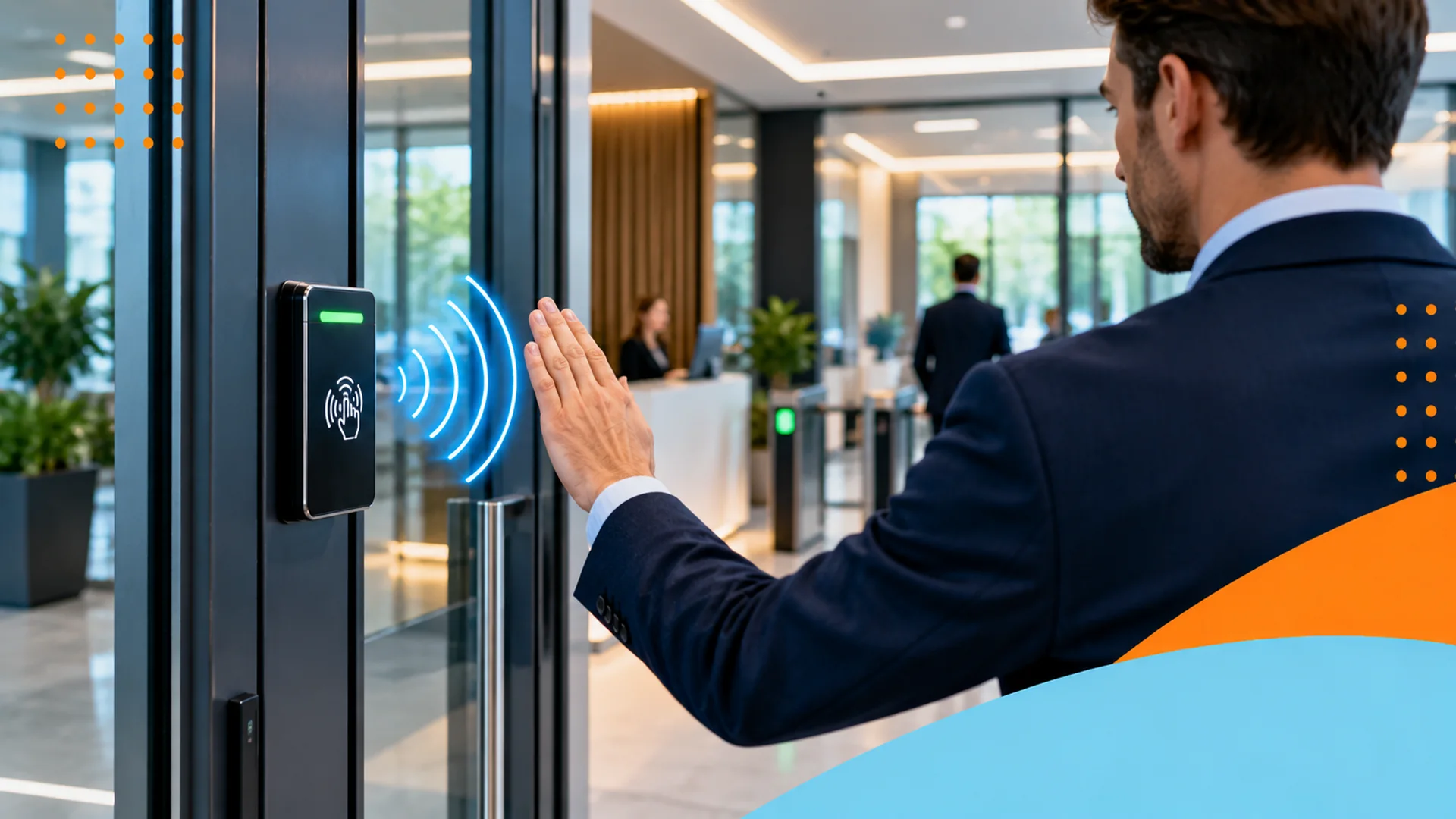
Touchless access control has become increasingly common in offices, schools, healthcare settings and other high-traffic public buildings.
The appeal is straightforward.
Users can enter controlled areas without repeatedly touching shared keypads, handles or readers, while organisations can often improve the speed and consistency of how people move through busy entrances.
But touchless access is not simply about hygiene.
When it is designed properly, it can also improve convenience, reduce bottlenecks and make access systems easier to manage.
As with any security technology, though, the benefits depend on how the system is specified and how it fits into the wider building.
What is touchless access control?
Touchless access control is a broad term covering systems that allow authorised users to gain entry without physically pressing buttons or making direct contact with a reader.
Depending on the system, this might include:
- mobile credentials
- proximity cards or fobs
- contactless readers
- automatic doors
- hands-free sensors
- facial or biometric technologies
- long-range credentials
- integration with visitor-management systems
The technology used will depend on the environment and the level of security required.
For some organisations, the objective is simply to remove shared touchpoints.
For others, the main benefit is faster movement through busy entrances.
TCNS Cabling designs and installs door entry and access control systems around how the building is actually used.
Why high-traffic buildings benefit
A small office with twenty employees has very different access requirements from a school, hospital or public building where hundreds of people may pass through the same entrance every day.
In high-traffic environments, small delays become significant.
If every user has to stop, locate a card, press a keypad or wait for somebody to release a door manually, queues can develop quickly.
Touchless systems can streamline that process.
That can be particularly useful around:
- main entrances
- staff-only areas
- reception points
- internal secure zones
- car park access
- plant rooms
- high-use corridors
- shared facilities
The aim is to keep authorised people moving while maintaining control over who can enter.
Hygiene is part of the appeal
The hygiene argument is obvious.
Traditional access systems can involve repeated contact with keypads, push buttons and other shared surfaces.
In healthcare, education and public-facing buildings, reducing unnecessary contact can be helpful.
Touchless access can remove some of those shared touchpoints.
However, it is important not to overstate this.
Access-control technology does not replace normal cleaning, hygiene or infection-control procedures.
It simply removes one unnecessary point of repeated physical contact.
That can still be valuable, particularly in locations where large numbers of people use the same entrance every day.
Speed can matter just as much
For many organisations, speed is actually the bigger operational benefit.
Consider the start of a school day, a hospital shift change or hundreds of staff arriving at an office between 8.30am and 9.00am.
The access-control system needs to cope with that demand.
Slow authentication can create queues.
Queues can create frustration.
They can also create security problems if people begin holding doors open or following others through simply to keep people moving.
A well-designed touchless system can help authorised users move through quickly without weakening control.
The technology must still be matched to the expected volume of users.
Not every door needs the same solution
One of the most common design mistakes is assuming that every controlled door should operate in exactly the same way.
It rarely needs to.
A main staff entrance may benefit from fast contactless access.
A secure server room may need stronger authentication.
A reception entrance may need to accommodate visitors, staff and deliveries.
An internal plant room may only be accessed occasionally by a small number of authorised engineers.
The correct approach is to consider the risk and operational requirement of each area.
That is why door entry and access control should be designed as a system rather than treated as a collection of individual readers.
The role of mobile credentials
Mobile credentials fit naturally into touchless access control.
Instead of carrying a plastic card, the user presents a smartphone to the reader.
In some systems, the interaction may require very little physical contact with the device or reader.
This can make access more convenient while also simplifying the way credentials are issued and revoked.
Mobile credentials can be particularly useful for:
- staff working across several sites
- temporary workers
- contractors
- visitors
- organisations with frequent starters and leavers
However, mobile access should still be supported by sensible fallback procedures.
Phones get lost.
Batteries go flat.
Devices are replaced.
A good system needs to account for normal human behaviour.
Touchless does not mean insecure
Some organisations worry that making access easier will automatically make it less secure.
That does not need to be the case.
Convenience and security are not opposites.
The important factor is the strength of the credential and how the access-control rules are configured.
A touchless system can still restrict:
- which doors a user can open
- what times access is permitted
- how long temporary access remains valid
- which sites the credential works at
- whether access events are logged
- how quickly credentials can be revoked
In fact, digital credential management can sometimes provide better control than traditional physical keys.
A lost metal key may require locks to be changed.
A lost digital credential can often be disabled immediately.
Tailgating still needs attention
Touchless access control does not automatically prevent tailgating.
An authorised user may open a door and another person can still follow them through.
That problem exists regardless of whether the door was opened with a card, smartphone or touchless reader.
High-security or high-traffic environments may therefore need additional measures.
These can include:
- turnstiles
- speed gates
- anti-passback rules
- reception controls
- security personnel
- CCTV coverage
- visitor-management processes
- staff awareness
A nearby CCTV system can also provide useful context when investigating access events.
The access-control system may show that a credential was used.
CCTV can help show what actually happened at the door.
Visitors are a different challenge
Staff access is usually predictable.
Visitor access is not.
Public buildings may receive contractors, parents, patients, suppliers, interviewees and other visitors throughout the day.
Touchless technology can help make that process more efficient.
For example, a pre-registered visitor may be issued with temporary digital access before arriving.
That credential could be restricted to:
- a specific building
- selected areas
- a particular date
- a limited time window
Once the visit has ended, access can expire automatically.
That can reduce the need to issue and recover physical visitor passes.
However, visitor security still needs to be carefully managed.
Convenience should not result in visitors receiving broader access than necessary.
Integration matters
Modern access-control systems increasingly depend on network connectivity.
Readers, controllers, management platforms and associated systems may all rely on the underlying infrastructure.
That means access-control projects should not be designed in isolation.
The structured cabling supporting the system needs to be reliable.
Network resilience needs to be considered.
Power requirements also matter.
Where access systems integrate with CCTV, visitor management or other building technologies, the infrastructure design becomes even more important.
That is one advantage of considering security and connectivity together rather than commissioning each system separately.
Fire and emergency requirements come first
Access control must never compromise safe emergency egress.
Controlled doors need to operate correctly in the event of an emergency.
Depending on the building and door type, that can involve interfaces with fire alarms, emergency release devices and other life-safety systems.
This is an area where professional design is essential.
A door that works perfectly during normal operation but behaves incorrectly during an emergency is not an acceptable installation.
Security should control entry without preventing safe exit.
Existing systems may not need replacing
Introducing touchless access does not always mean replacing everything already installed.
In some buildings, existing controllers, cabling or door hardware may be capable of supporting newer readers or credentials.
A survey can establish what can be retained and what genuinely needs to change.
That can make upgrades significantly more cost-effective.
It can also reduce disruption in occupied buildings.
Replacing equipment simply because a newer product exists is rarely the best approach.
The better question is whether the existing system can safely and reliably support the organisation’s current and future requirements.
Think about the user journey
Access-control projects are often discussed in terms of readers, locks and credentials.
But the user experience matters too.
Consider what happens from the moment somebody arrives at the site.
Where do they enter?
How do they authenticate?
What happens if access is refused?
Where do visitors go?
What happens during busy periods?
Can reception help remotely?
How do disabled users interact with the entrance?
What happens outside normal hours?
Those questions often reveal more about the right solution than simply comparing products.
The best systems are secure without becoming unnecessarily difficult to use.
Is touchless right for every site?
No.
There are plenty of environments where a conventional contactless card system continues to work perfectly well.
Touchless technology should be introduced because it provides a clear benefit.
That benefit may be:
- reducing shared touchpoints
- improving access speed
- managing visitors more efficiently
- reducing lost-card administration
- creating a better user experience
- centralising access across several sites
If none of those issues are significant, there may be little reason to change.
Technology should always solve an operational problem.
Design around the building
Successful access control begins with understanding the building.
Who uses it?
When are the busiest periods?
Which areas are sensitive?
How are visitors managed?
What happens during an emergency?
What systems already exist?
Once those questions are understood, it becomes much easier to choose the appropriate technology.
TCNS Cabling provides door entry and access control, structured cabling, CCTV and Wi-Fi infrastructure, allowing the wider building infrastructure to be considered together.
Touchless access control can improve hygiene, convenience and movement through busy buildings.
But the technology works best when it is designed around the people and environment it needs to protect.

Be the first to comment