

The recent announcement that Cambium-Networks-Company-Statement-Sep-16-2026.pdf confirms that Cambium Networks Limited entered administration on 14 September 2026 has understandably created uncertainty for customers and partners relying on Cambium’s networking portfolio. The statement notes that production of Wi-Fi access points, cnMatrix switches and NSE devices has been discontinued while administrators explore potential going-concern transactions. For many organisations, this has prompted an immediate review of their network strategy and long-term technology roadmap. Cambium-Networks-Company-Statement-Sep-16-2026.pdf
While existing Cambium customers assess their options, the situation highlights an important lesson for every IT decision-maker: selecting a networking vendor should extend far beyond technical specifications and pricing. Vendor stability, innovation, support capability and market vision are equally important considerations when investing in infrastructure that is expected to support the organisation for many years.
Looking Beyond Features and Cost
When evaluating a wired or wireless networking solution, organisations often focus on:
·
- Switching capacity
- Security features
- Cloud management capabilities
- Licensing models
- Initial acquisition costs
- Coverage and performance
These factors are undoubtedly important, but the recent developments within Cambium demonstrate why organisations must also evaluate the long-term viability of the manufacturer itself.
A network infrastructure platform is rarely a short-term investment. Most organisations expect their wired and wireless infrastructure to remain operational for between five and ten years. During that period, customers depend on the manufacturer to continue innovating, providing software updates, addressing security vulnerabilities and delivering reliable technical support.
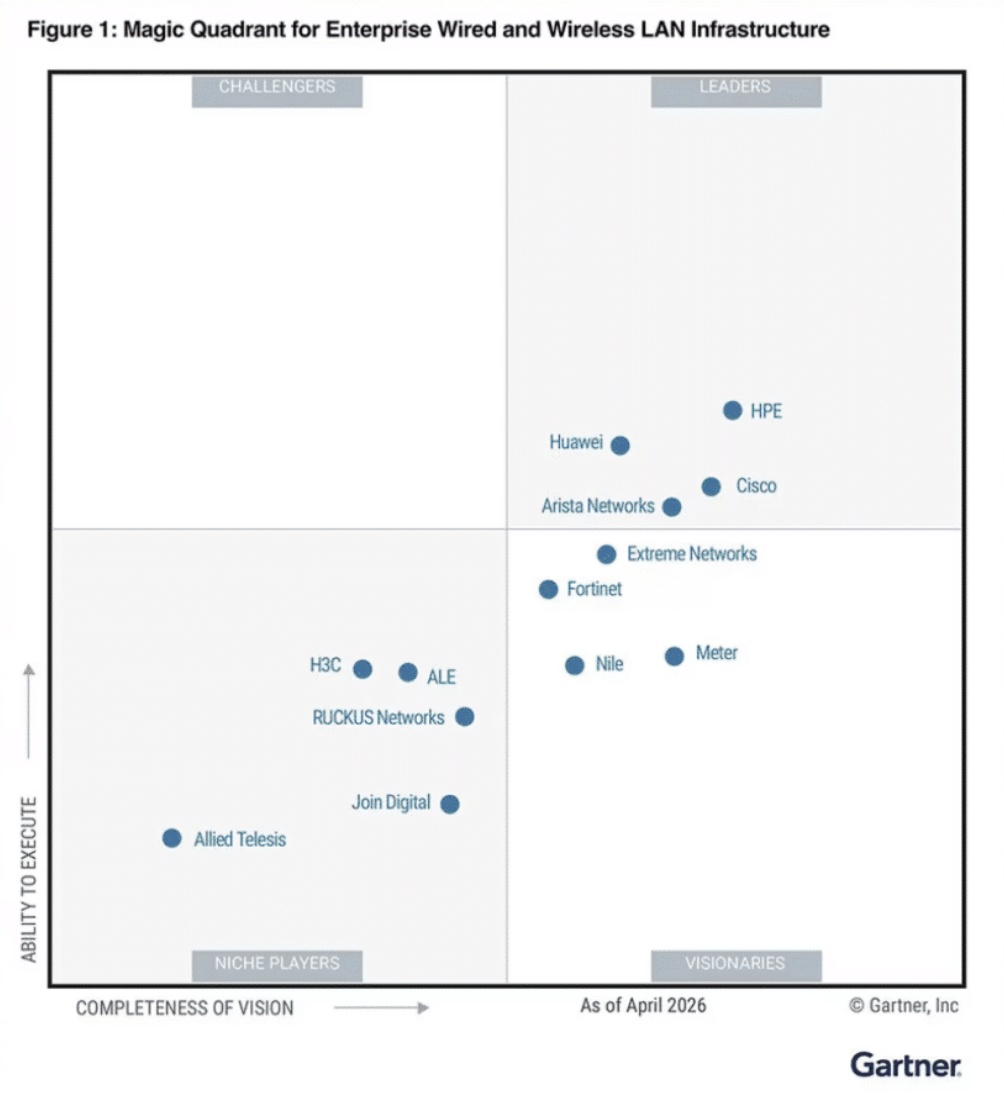
The Gartner Magic Quadrant as a Strategic Decision-Making Tool
One of the most valuable resources available to organisations assessing alternative networking vendors is the Gartner Magic Quadrant for Enterprise Wired and Wireless LAN Infrastructure.
Rather than focusing solely on product features, Gartner evaluates vendors against two key criteria:
· Ability to Execute
· Completeness of Vision
This provides organisations with an independent assessment of a vendor’s market position, financial strength, innovation capability and long-term strategic direction.
The Magic Quadrant helps IT leaders look beyond vendor marketing and gain a clearer understanding of which manufacturers are best positioned to support customers over the long term.
The Importance of Market Leaders
In recent years, manufacturers such as HPE Aruba Networking, Juniper Networks and Cisco have consistently been recognised as key players within the enterprise networking market and are frequently included in discussions around enterprise wired and wireless infrastructure.
HPE Aruba Networking
HPE Aruba Networking has established a strong reputation for delivering enterprise-grade wired and wireless solutions supported by cloud-native management, advanced AI-driven operations and comprehensive security capabilities.
Aruba’s focus on user experience, automation and operational simplicity has made it a popular choice across healthcare, education, government and enterprise sectors. The platform’s ability to provide unified management across campus, branch and remote environments continues to resonate with organisations pursuing digital transformation initiatives.
Juniper Networks
Juniper has gained significant market attention through its AI-Native Networking strategy, powered by the Mist platform.
The vendor’s focus on artificial intelligence, proactive troubleshooting and user experience has transformed expectations around network operations. Many organisations are attracted to Juniper’s ability to reduce operational complexity while delivering detailed analytics and automated remediation capabilities.
For organisations looking to reduce support overheads and improve end-user experience, Juniper is often viewed as a highly innovative option.
Cisco
Cisco remains one of the most recognised and widely deployed networking manufacturers globally.
With an extensive portfolio spanning wireless networking, switching, routing, security and observability, Cisco offers organisations a broad technology ecosystem that can support complex enterprise requirements. Its global support infrastructure, mature partner network and ongoing investment in innovation continue to make Cisco a strong contender in many enterprise networking projects.
For organisations seeking a vendor with significant market presence, financial strength and a comprehensive product portfolio, Cisco remains a common benchmark against which other networking providers are assessed.
Understanding the Four Quadrants
The Gartner Magic Quadrant categorises suppliers into four key segments:
Leaders
Leaders combine strong execution with a well-defined future vision. These vendors typically demonstrate:
- Strong customer satisfaction
- Consistent innovation
- Significant R&D investment
- Robust global support capabilities
- Financial stability
Challengers
Challengers execute effectively and often possess significant market presence but may have a less differentiated long-term strategy.
Visionaries
Visionaries introduce innovative technologies and disruptive ideas but may still be developing the operational scale of larger competitors.
Niche Players
Niche Players often focus on specific use cases, markets or geographic regions. While they may provide excellent solutions within their chosen areas, organisations should carefully assess long-term product strategy and support capabilities.
Building a Vendor Selection Framework
Whilst Gartner’s analysis provides valuable independent insight, organisations should combine it with a structured evaluation process that includes:
- Proof-of-concept deployments
- Total cost of ownership assessments
- Technical architecture reviews
- Support and service evaluations
- Future roadmap discussions
- Reference visits and customer testimonials
The objective should be to identify a vendor that not only meets today’s networking requirements but also aligns with the organisation’s long-term technology strategy.
A Timely Reminder for Network Decision-Makers
The administration of Cambium Networks serves as a timely reminder that selecting a networking partner is about far more than selecting access points and switches. Organisations are ultimately choosing a technology partner whose products, support services and strategic direction will underpin business operations for years to come. Cambium-Networks-Company-Statement-Sep-16-2026.pdf
By leveraging independent analyst resources such as the Gartner Magic Quadrant and evaluating established market leaders including HPE Aruba Networking, Juniper Networks and Cisco, organisations can make more informed decisions that balance innovation, operational excellence and long-term business resilience.
In a market where network infrastructure supports everything from cloud applications and hybrid working to AI-driven services and cybersecurity, choosing the right vendor has never been more important. The lessons emerging from the Cambium situation reinforce the value of thorough due diligence and the importance of considering both technology and vendor stability when planning future network investments.

Be the first to comment